Literary Ghosts · 10 min
The Locked Chest of Emily Dickinson
The Locked Chest of Emily Dickinson: Letters, Ghosts, and the Poet Who Haunted Herself
By The Archivist | The Haunted Record*
—
On a Saturday afternoon in May 1886, the factory whistle in Amherst, Massachusetts, sounded for six o’clock. Somewhere inside the butter-colored brick house at 280 Main Street, Emily Elizabeth Dickinson stopped breathing. Her brother Austin recorded the moment in his diary with the precision of a man accustomed to legal documents: “The day was awful… she ceased to breathe that terrible breathing just before the whistle sounded for six.”
She was fifty-five years old. Her physician, Dr. Orvis Bigelow, attributed the cause to Bright’s disease — a kidney failure that had confined her to bed for the final weeks of her life. She had requested a white coffin. She had requested flowers. She had requested that her body be carried out the back door of the Homestead, through the barn, and across the fields to West Cemetery — never touching a public road.
She had also, according to every surviving account, requested that her papers be burned.
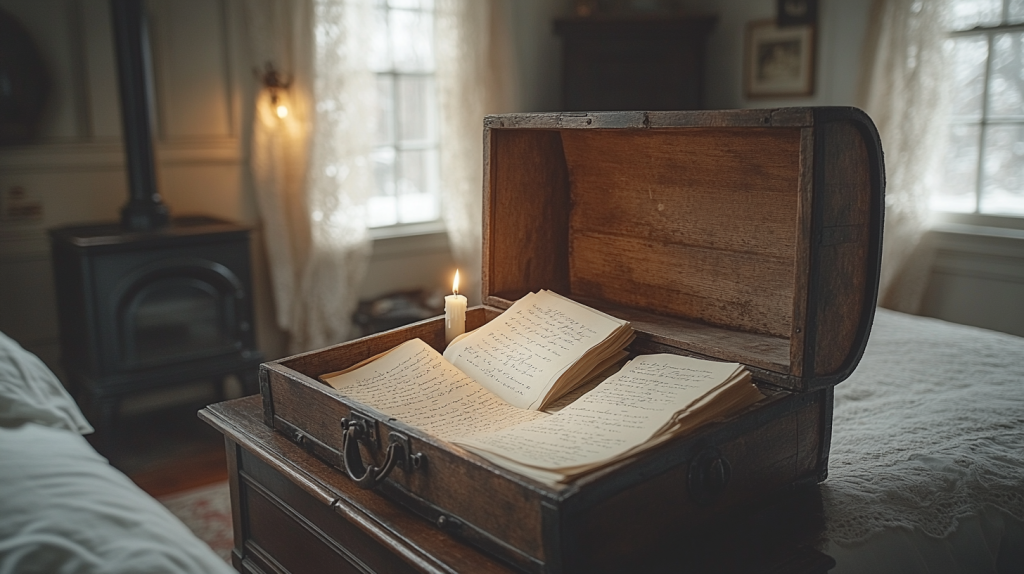
Her sister Lavinia honored almost every wish. But one week after the funeral, when Lavinia entered Emily’s bedroom to sort through her effects, she opened a bureau drawer and then a locked wooden chest, and she made a discovery that would render the burning impossible. Inside that chest lay forty hand-sewn booklets — pages of cream-colored stationery pierced with holes and bound with string — containing nearly eighteen hundred poems that no one outside a tiny circle of correspondents had ever read.
Lavinia later described the find as “a box (locked) containing 7 hundred wonderful poems carefully copied.” The actual number would prove far greater. Alongside the fascicles were loose sheets, scraps of envelope, the backs of recipes, and jottings in a slanted, nearly illegible hand that one of Emily’s own correspondents had compared to “the famous fossil bird tracks in the museum of that college town.”
The poems were alive. Emily had asked that very question — whether her verse was alive — in her first letter to Thomas Wentworth Higginson, a total stranger, on April 15, 1862. She had enclosed four poems and a card with her name written in pencil, tucked inside a smaller envelope sheltered within the larger one. As if, Higginson later wrote, the shy writer wished to recede as far as possible from view.
That instinct to recede — to exist as a voice without a body, a mind without a corporeal form — is the thread that runs through every letter Emily Dickinson ever wrote. And it is the thread that makes the Dickinson Homestead one of the most quietly unsettling literary sites in America. Not because of any sensational haunting. But because Emily Dickinson understood haunting better than anyone who has ever put pen to paper, and she practiced it in life before anyone could attribute it to her in death.
“Nature Is a Haunted House — but Art — a House That Tries to Be Haunted”
Emily wrote that line to Higginson in 1876, in Letter 459a of their twenty-four-year correspondence — a correspondence that now survives as approximately seventy letters from her side alone, since Higginson’s replies were either burned at her death (on her instructions to Lavinia) or lost to time.
The sentence is not a metaphor. It is a thesis. Nature, Dickinson argued, is already saturated with the uncanny — decay, transformation, the constant adjacency of life and death in every garden bed and frost line. Art, by contrast, must work to achieve that same condition. Art must try to become haunted.
Dickinson tried harder than most. In an 1869 letter to Higginson — the same man she called “the Friend that saved my Life” — she wrote what may be the most precise definition of a ghost ever committed to correspondence: “A Letter always feels to me like immortality because it is the mind alone without corporeal friend. Indebted in our talk to attitude and accent, there seems a spectral power in thought that walks alone.”
A spectral power in thought that walks alone. She was describing letters. She was also describing herself.
The Woman in White at the North-West Passage
By the late 1860s, Emily Dickinson had largely withdrawn from direct social contact. She communicated through letters, through poems enclosed with gifts of flowers and baked goods, and through closed doors. When the young pianist Mabel Loomis Todd arrived in Amherst in the early 1880s — she would later become Austin Dickinson’s lover and Emily’s first posthumous editor — she was invited to play the Homestead’s piano. Emily listened from what she wryly called “the North-West Passage,” the shadowed hallway just beyond the parlor. Todd never saw her. At the end of each performance, a glass of sherry on a silver salver appeared, sent on instruction from this hidden but attentive listener.
This was not agoraphobia. This was not mere eccentricity. This was a woman who had thought deeply about the relationship between presence and absence, body and voice, the seen and the unseen — and who had chosen her side of that divide with absolute deliberation.
Her niece Martha Dickinson Bianchi, who later edited several volumes of the poetry and wrote *Emily Dickinson Face to Face*, perpetuated the image of the recluse, the woman in white who drifted through the upper rooms of the Homestead like a figure from one of her own poems. But the correspondence tells a different story. Emily Dickinson was not withdrawn from the world. She was ferociously engaged with it — through ink, through paper, through the spectral technology of the letter.
The Master Letters: Three Drafts to No One
Among the most disturbing documents found in the locked chest were three undated letter drafts addressed to someone Dickinson called only “Master.” They were never sent — or if they were, the fair copies have never surfaced. R. W. Franklin, who published a facsimile edition through Amherst College Press in 1986, dated them to 1858, early 1861, and summer 1861 respectively. He wrote that they “stand near the heart of her mystery.”
The first begins: “Dear Master / I am ill — but grieving more that you are ill, I make my stronger hand work long eno’ to tell you.”
The identity of Master has never been conclusively established. Scholars have proposed the Reverend Charles Wadsworth (whose own letters to Dickinson do not survive), the newspaper editor Samuel Bowles (whom she called “Queen” and “Daisy” in return), the scientist William Smith Clark, and Judge Otis Phillips Lord (who became a confirmed romantic interest only in the late 1870s, after his wife Elizabeth’s death). Feminist scholars including Lillian Faderman and Adelaide Morris have argued the letters may have been addressed to Susan Gilbert Dickinson — Emily’s sister-in-law, her most prolific correspondent, and the recipient of more poems than any other person in Dickinson’s life.
Others have suggested the Master is God. Or the Devil. Or no one at all — that the letters are literary exercises, performances of longing addressed to an invented recipient.
What matters for our purposes is not who Master was. What matters is that three passionate, anguished, nearly incoherent letters were found locked in a dead woman’s chest, addressed to a name that was not a name, in a hand that shook with emotion, and that they had been kept — sealed, unsent, preserved — for a quarter century in the dark.
If that is not a haunting, the word has no meaning.
## The Homestead Today: 280 Main Street
The Dickinson Homestead stands today as part of the Emily Dickinson Museum, operated in partnership with Amherst College, which purchased the property in 1965 after it narrowly escaped demolition. The Homestead — built in 1813 by Emily’s grandfather Samuel Fowler Dickinson and converted to its current Italianate style in 1855, when the family added a yellow exterior, green shutters, and a cupola — sits alongside The Evergreens, the adjacent home where Austin and Susan Dickinson raised their three children.
Recent restorations have returned the interior to its appearance during Emily’s writing years. The parlor features a reproduction of the colorful Brussels carpet that once drew Amherst’s society ladies to arrive early at Mrs. Dickinson’s gatherings just to glimpse the pattern beneath their skirts. Emily’s bedroom still contains her black cast-iron stove, ornamented with Ionic pilasters. Visitors are encouraged to play the recently donated mid-nineteenth-century piano by Hallet, Davis, and Company — the same Boston manufacturer that built Emily’s own instrument, which now resides at Harvard’s Houghton Library.
The tiny writing desk — an eighteen-inch square with a single small drawer — sits where it always sat. It was here, on scraps and envelopes and the backs of household recipes, that nearly eighteen hundred poems were written in a hand so difficult that Higginson compared it to fossil tracks.
Museum visitors and staff have reported the quiet sense that the rooms are not entirely empty. Laura Holland, a writer and artist who attended the poet’s Birthday Open House at the Museum in December 2022, described the experience of standing in the restored parlor as feeling like “past and present were partying together.” She was not speaking of a conventional ghost sighting. She was speaking of something Emily Dickinson would have recognized immediately — the spectral power in thought that walks alone.
The Burning and the Keeping
Here is the detail that should unsettle anyone who reads the historical record carefully. Emily Dickinson left instructions to burn her papers. Lavinia honored that instruction for the correspondence — she burned what she knew of Emily’s received letters. But when she opened the chest and found the poems, she made a different choice. She later wrote to Higginson with the fervor of a convert: “I have had a ‘Joan of Arc’ feeling about Emilies poems from the first.”
Lavinia did not burn the poems. She did not burn the Master Letters. She did not burn the fascicles. She carried them out of the dark wooden chest and into the light, and she spent the rest of her life ensuring they reached print — first through Mabel Loomis Todd and Higginson (whose 1890 *Poems of Emily Dickinson* became a popular sensation), then through the long, bitter rivalry between the Todd and Dickinson families that would stretch across decades, lawsuits, and competing editions.
The poems survived because one woman decided that her dead sister’s instructions were wrong.
Emily Dickinson wrote approximately eighteen hundred poems about death, immortality, absence, the boundaries between the living and the dead, and the unbearable nearness of eternity. She wrote them in a locked room, stored them in a locked chest, and asked that they be destroyed.
They were not destroyed. They walked out into the world — spectral, bodiless, immortal — exactly as she had described a letter walking: the mind alone, without corporeal friend.
The question is not whether Emily Dickinson haunts the Homestead at 280 Main Street. The question is whether she ever stopped.
—
*The Archivist writes from primary sources. The letters quoted in this piece are drawn from Thomas H. Johnson and Theodora V. Ward’s* The Letters of Emily Dickinson *(Belknap Press, 1958), R. W. Franklin’s* The Master Letters of Emily Dickinson *(Amherst College Press, 1986), and the holdings of the Emily Dickinson Archive at Amherst College. Austin Dickinson’s diary entry is cited in multiple biographies, including Richard B. Sewall’s* The Life of Emily Dickinson *(Farrar, Straus, Giroux, 1974). Mabel Loomis Todd’s editorial history is documented in Millicent Todd Bingham’s* Ancestors’ Brocades: The Literary Debut of Emily Dickinson *(Harper & Brothers, 1945). The Dickinson Homestead restoration details are drawn from the Emily Dickinson Museum’s public materials and reporting in* The Magazine Antiques *(January 2023).*
—
Planning a visit?** The Emily Dickinson Museum at 280 Main Street, Amherst, MA offers guided tours of both the Homestead and The Evergreens. Timed tickets must be purchased in advance at [emilydickinsonmuseum.org](https://www.emilydickinsonmuseum.org). The 90-minute “Emily Dickinson’s World” tour covers both historic homes; the 45-minute “This Was a Poet” tour focuses on the Homestead alone.
*Dead is So Alive.*
Leave a comment