New Orleans · 11 min
The Dark History of the LaLaurie Mansion: New Orleans’ Most Haunted House
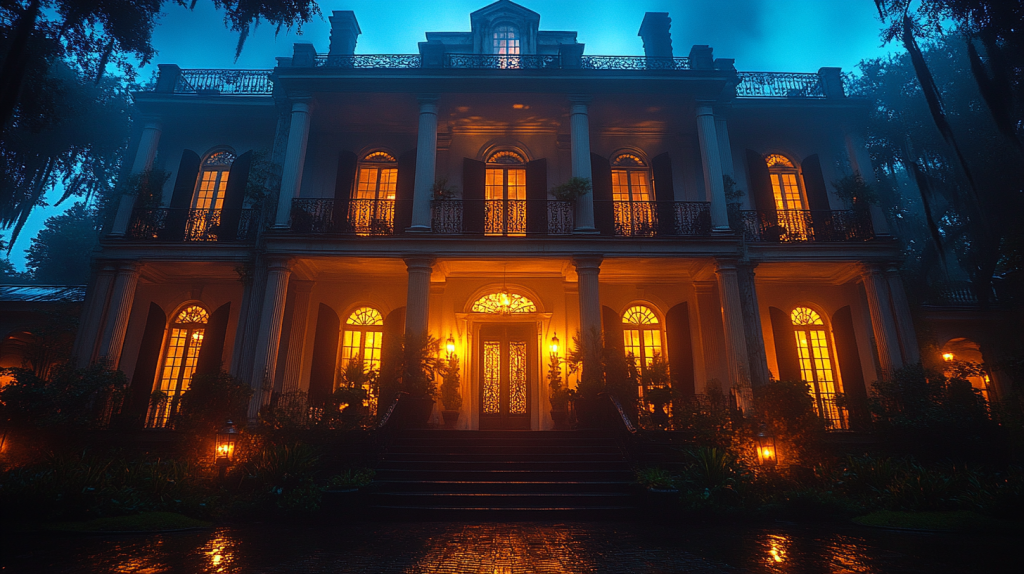
At 1140 Royal Street in New Orleans’ French Quarter, a three-story Empire-style mansion stands behind ornate wrought-iron balconies, its pale facade unremarkable among the elegant buildings that crowd this stretch of the Quarter. Tour groups gather on the sidewalk below after dark, necks craned upward. Some claim to feel something before the guide says a word. Some report seeing a figure at the roofline — a small shape that appears at the edge, then simply isn’t there.
Whether or not you believe that, what happened inside this building in April 1834 is documented, verified, and in many ways more disturbing than any ghost story attached to it. The LaLaurie Mansion is not famous because of what people imagine happened here. It is famous because of what did.
Historical Background of the LaLaurie Mansion
The mansion at 1140 Royal Street was constructed in 1832 for Delphine LaLaurie and her third husband, physician Dr. Leonard Louis Nicolas LaLaurie. Delphine, born Marie Delphine Macarty on March 19, 1787, came from one of the most prominent Creole families in Louisiana. By the time she took up residence on Royal Street, she had already been widowed twice and was regarded as one of the city’s most sophisticated hostesses.
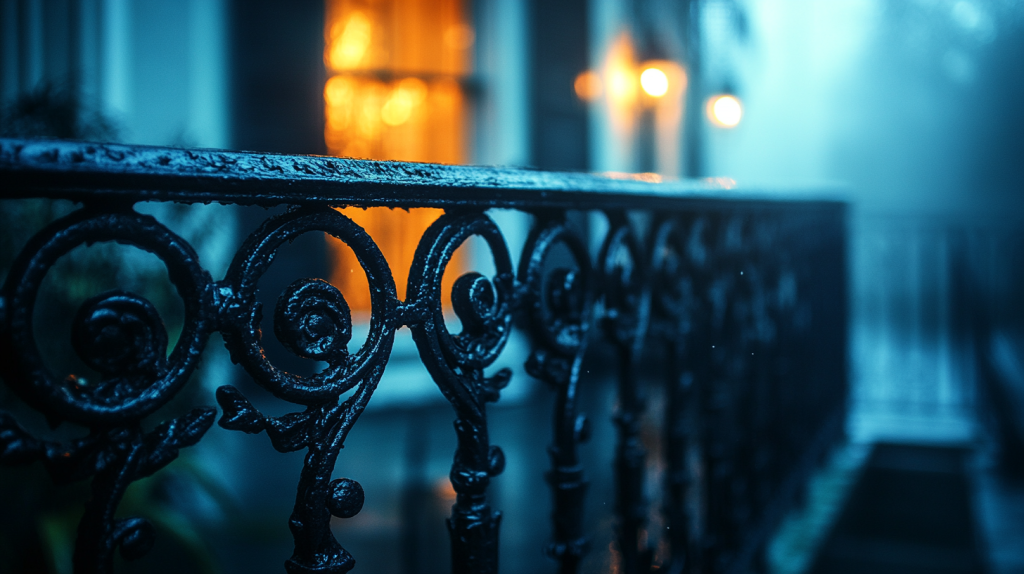
The building she commissioned reflected that status precisely. Three stories of brick construction with distinctive wrought-iron galleries, French doors opening onto exterior balconies, a private interior courtyard — this was a home designed to be seen and admired. It placed the LaLauries at the center of New Orleans’ elite social world, hosting parties that drew politicians, merchants, and the most influential families in the city.
What no guest appeared to know — or, troublingly, what some may have suspected and ignored — was what was happening in the upper floors of that same building.
A Warning Hidden in Plain Sight
There were signs before 1834, if anyone had been willing to look. Court records show that in 1828, Delphine LaLaurie was fined $300 for the mistreatment of an enslaved child. That fine — the legal system working exactly as it was designed to within a slave-holding society — constituted the full extent of accountability. The parties continued. The social invitations kept coming.
Neighbors reportedly noticed other things over the years. An enslaved girl, later estimated to be around twelve years old, was seen running across the rooftop in apparent terror — fleeing something or someone inside — and falling. What happened to the child is part of the documented record, and we will return to her.
Madame Delphine LaLaurie: The Woman Behind the Legend
It is tempting, and perhaps easier, to turn Delphine LaLaurie into a monster — a figure so extreme she can be set apart from the society that produced her. The historical record resists that simplification.
She was a product of New Orleans’ Creole elite, educated, multilingual, and by all external accounts charming. She had navigated the death of two husbands and emerged with her wealth and social standing intact. Her third marriage, to Dr. LaLaurie, maintained both. The enslaved people who maintained her household — who cooked her food, dressed her children, served her guests — were, under Louisiana law, her property.
What distinguishes Delphine LaLaurie from other slaveholders of her era was not the fact of enslavement but the documented nature and degree of what she inflicted. Even within a society that had normalized extraordinary violence, what was found in her attic on April 10, 1834 provoked shock that rippled through the city.
She died on December 7, 1849, in Paris, having never faced criminal prosecution for anything that happened at 1140 Royal Street. Her remains were reportedly returned to New Orleans and buried in St. Louis Cemetery No. 1 — a few blocks from the mansion where her victims suffered. The grave has no marker that acknowledges what happened there.
April 10, 1834: The Fire and What It Revealed
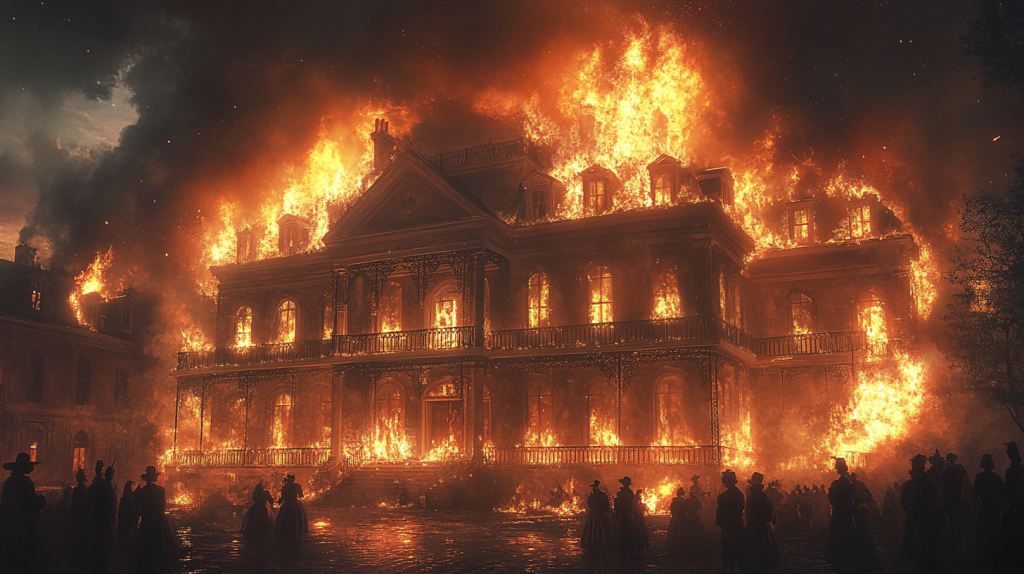
The fire that exposed the LaLaurie household did not start by accident.
An elderly enslaved woman — her name does not appear in the surviving records, erased by the same system that had chained her — was the cook for the LaLaurie household. She had been kept shackled to the kitchen stove, reportedly for months. On April 10, 1834, she set the kitchen on fire deliberately. Accounts collected in the aftermath suggest she told rescuers she would rather risk death than allow more enslaved people to disappear into the upper floors and never return.
That act of calculated defiance is the reason any of the survivors in the attic were ever found.
When firefighters and bystanders forced their way into the locked upper chambers, they found seven people — though some period accounts suggest the number may have been higher. The New Orleans Bee (L’Abeille de la Nouvelle-Orléans) published its report on April 11, 1834, describing the survivors as bearing evidence of prolonged confinement and physical harm that the paper’s editors called difficult to put into words. Judge Jean-François Canonge, who led the official inquiry, documented the use of iron collars, restraints, and conditions suggesting systematic abuse over an extended period.
The rescued individuals were taken to the local jail — not for any crime, but because it was the only public institution with space to receive them. New Orleanians lined up to see them. The Bee reported that the sight moved observers to open tears.
What the Historical Record Actually Confirms
Because the LaLaurie story has been retold and embellished across nearly two centuries, it is worth being precise about what contemporary documentation supports versus what accumulated later:
- Confirmed by 1834 sources: The deliberate fire; discovery of enslaved survivors in the locked upper floors; evidence of iron restraints; severe physical conditions; the public mob that followed; the LaLauries’ flight from New Orleans
- Confirmed by earlier records: The 1828 fine for enslaved child abuse; the incident involving the girl on the rooftop
- Appearing in later accounts, unverified by 1834 sources: Specific descriptions of surgical equipment; claims of medical experimentation; exact numbers beyond those documented by Judge Canonge
The distinction matters — not to diminish what occurred, but because the documented reality is damning enough. The embellishments that entered the record in the 1890s and later actually do a disservice to the people who were there, replacing their specific suffering with generalized horror-story imagery.
The Mob, the Flight, and the Aftermath
News of what had been found spread through the French Quarter within hours. By evening, a crowd had gathered outside 1140 Royal Street. Accounts describe somewhere between two hundred and several thousand people — estimates vary wildly — who ransacked and severely damaged the mansion before the LaLauries fled.
Delphine LaLaurie and her husband escaped by carriage to Lake Borgne, then to a waiting schooner, and ultimately to France. No extradition. No trial. The legal architecture of antebellum Louisiana offered no mechanism to prosecute a slaveholder for the treatment of enslaved people — even for this.
The seven survivors documented by Judge Canonge were eventually released. Their names do not appear in the historical record with the same persistence as Delphine LaLaurie’s. This, too, is part of the story.
The mansion was rebuilt after the mob damage and changed hands repeatedly throughout the 19th and 20th centuries. It served at various points as a school for Black girls, a conservatory of music, a tenement, a furniture store, and private apartments. Actor Nicolas Cage purchased the property in 2007 before financial difficulties led to its sale. It has been a private residence ever since.
The Haunting: What People Report, and Why It Matters
Here is where any honest chronicler of this place has to make a decision about what they believe — or more accurately, what they don’t know.
The paranormal claims attached to the LaLaurie Mansion are among the most persistent in New Orleans. Not just the tourist-circuit variety, but accounts from people who owned or occupied the building across two centuries — people with no particular interest in promoting ghost stories and often considerable interest in denying them.
What gets reported, consistently, breaks down into several categories:
The Girl at the Roofline
The most frequently reported apparition at the LaLaurie Mansion is a young girl seen at the edge of the roof, particularly on the upper gallery facing Royal Street. She appears, witnesses say, and then is gone.
This is not an anonymous ghost story. In the years before 1834, a young enslaved girl — estimated by neighbors to be around twelve years old — was witnessed running across the roof of the LaLaurie property, apparently fleeing inside the house. She fell. What happened to her is recorded in the social memory of the neighborhood, if not always in formal documents. Her name has not survived.
If there is a ghost at the roofline of 1140 Royal Street, the history tells you who she might be.
The Sounds of the Upper Floors
Tenants and owners over the decades have consistently reported sounds from the upper floors: footsteps, the dragging sound described as chains, voices. Multiple former residents, across different eras of the building’s history, have described waking to noises from rooms that were empty.
The upper floors are where the locked chambers were. Where Judge Canonge’s inquiry took place. Where the cook’s act of self-sacrificing defiance drew the first rescuers.
Whether those sounds have a supernatural explanation is not something this writer can tell you. What is not in dispute is the history of what happened in those rooms.
The Woman in 19th-Century Dress
Separate from the girl on the roof, numerous accounts describe a figure inside the building — a woman in period clothing, moving through hallways and disappearing. Many who describe her identify the clothing as consistent with the 1830s.
Whether this is Delphine LaLaurie, restless in death in a way she never was in life, is a question no one can answer. She died in Paris in 1849. She may or may not be buried in New Orleans. The mansion she fled still stands.
The Other Presences
Perhaps more significant than the sightings of LaLaurie herself are accounts of figures that don’t match her description — shadowy shapes in doorways, voices in French from empty rooms, a sense of being watched on the upper stairs. If the mansion is haunted by anyone, the historical record suggests it would most plausibly be haunted by the people who suffered there, not the woman who inflicted the suffering.
That framing — which gets less attention in most paranormal accounts — is worth sitting with.
Ethical Weight and the Ghost Tour Problem
Every night in New Orleans, dozens of tour groups gather outside 1140 Royal Street. Guides share the LaLaurie story, describe the paranormal activity, point to the roofline. Tourists photograph the balconies. The story gets told again.
There is a real tension in this, and it’s worth naming. The LaLaurie Mansion is not primarily a ghost story. It is a site of documented atrocities committed against enslaved people whose names history has largely failed to preserve. When the paranormal angle becomes the headline, the suffering of real human beings becomes set dressing.
At the same time, the ghost story is inseparable from the history — and for many visitors, it’s the entry point. The question is whether the entry point leads somewhere honest.
The most responsible version of this story keeps the camera on the cook who set the fire. On the seven survivors whose names we don’t know. On Judge Canonge’s documented findings. On the 1828 fine that changed nothing. The ghosts, whatever you believe about them, are downstream of that history — not a replacement for it.
The Mansion Today
The LaLaurie Mansion remains a private residence. It is not open to tours. The wrought-iron balconies that Delphine LaLaurie commissioned in 1832 still face Royal Street, restored and maintained by owners who have to decide, every time someone asks about the building, how to answer.
The French Quarter has changed enormously since 1834. The legal architecture of slavery that made the LaLaurie household possible is gone. The mansion endures.
Visitors still gather on the sidewalk after dark. Some feel nothing. Some feel something they can’t explain. Almost all of them, somewhere in the tour, hear the story of the woman chained to the stove — the one whose name didn’t survive, whose deliberate act of defiance is the reason any survivors were found at all.
If this building has a presiding spirit, the history suggests it should be hers.
Conclusion
The LaLaurie Mansion is genuinely haunted by history — that much is not in dispute. Whether it is haunted by anything else is a question the building has refused to answer definitively for nearly two centuries, and in that refusal there is something appropriately unresolved.
What the documented record gives us is this: a woman of extraordinary social privilege who inflicted documented cruelties on enslaved people in a city that looked away until it couldn’t. A fire set deliberately by a woman whose name was not preserved. Seven survivors whose conditions shocked a slaveholding society’s own public. A flight to France. No trial. No criminal accountability.
The ghost tours will continue. The figure at the roofline will keep appearing and disappearing. And somewhere in the history, not very far beneath the surface, are the people who were actually there — whose suffering created the weight that still seems to settle over 1140 Royal Street, whatever you believe its source to be.
The LaLaurie Mansion is located at 1140 Royal Street in New Orleans’ French Quarter. It is a private residence and is not open to the public. Ghost tours of the French Quarter regularly pass the property — several are listed in our New Orleans ghost tour guide.
Leave a comment