Massachusetts · 8 min
The Ghost Who Never Left: Jerusha Howe and the Secrets of America’s Oldest Inn
The Wayside Inn: Three Centuries of Guests, Grief, and the Ghost Who Never Left
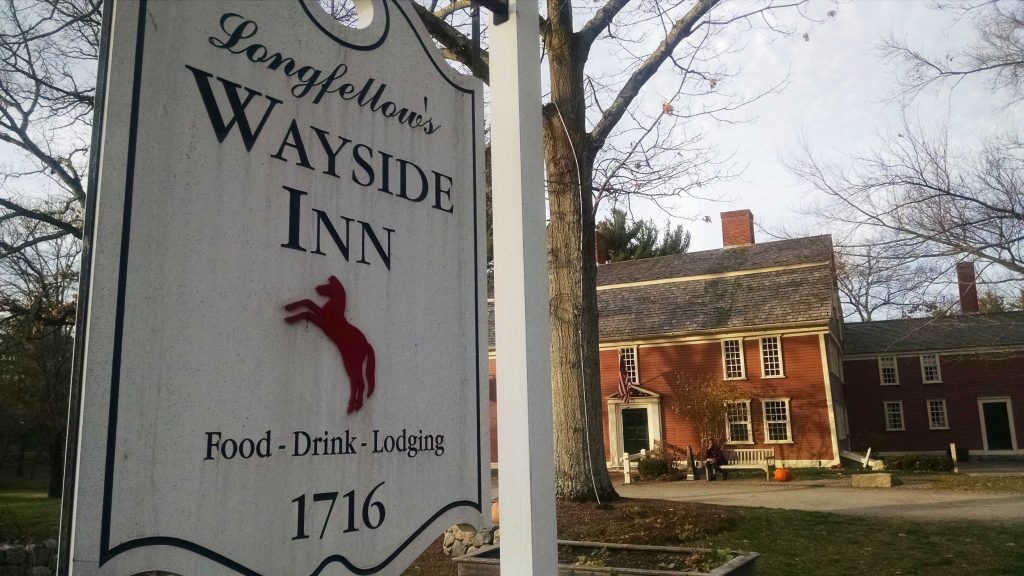
Along the Old Boston Post Road in Sudbury, Massachusetts, stands a building that has been hosting the living for over three hundred years. It has also, according to the record, been hosting at least one of the dead.
We reached out. She answered.
This is what we know — from the probate records, the innkeeper’s logs, the Middlesex County archives, and from Jerusha Howe herself, who called in to tell us the part the historians left out.
Who Built This Place, and Why It Mattered
The Wayside Inn did not begin as a romantic destination. It began as a necessity.
In 1716, David Howe — the name was later anglicized from “How” — received a license from the Middlesex County court to operate a tavern on his property along the Boston Post Road. The license, preserved in the county probate records, does not describe him as an innkeeper. It describes him as a “retailer of strong drink,” which tells you something important about the early function of the place: it was a waystation, not a destination. Travelers needed food, shelter, and information. Howe provided all three.
The Post Road was colonial America’s primary artery. A day’s hard ride from Boston, Sudbury was the point at which travelers had to make a decision: push on in the dark, or stop. Howe made stopping the obvious choice. The original structure was two rooms. By the time his son Ezekiel inherited the property, it had grown considerably — and so had its reputation.
What the tourist literature tends to skip is that this growth happened against a backdrop of near-constant violence and uncertainty. The Howes operated through King Philip’s War, through the smallpox epidemics of the early 18th century, through the political crises that preceded the Revolution. The guests who passed through were not leisurely travelers. They were, by and large, people moving through danger.
That context matters. It explains why the building accumulated so much history so quickly — and why some of that history, apparently, never left.
Jerusha Howe: The Name the Records Almost Lost
Here is what the official histories give you about Jerusha Howe: almost nothing.
She was the daughter of Ezekiel Howe, who operated the inn — then called the Red Horse Tavern — during the Revolutionary period. She was born sometime in the mid-18th century. She never married. She died in the inn. And according to more than two centuries of guest accounts, staff reports, and firsthand testimony, she has not entirely vacated the premises.
The story that has attached itself to Jerusha is this: she fell in love with a man — an Englishman, in some versions; a sea captain in others — who promised to return for her. He did not. She waited. She continued to wait, by most accounts, long after waiting ceased to be possible in any conventional sense.
Jerusha’s room — the chamber now known simply as the Red Room — is where most of the reported encounters occur. Guests have described the smell of perfume with no apparent source. Cold that does not correspond to drafts. The sense of being watched from the corner near the window. One 19th-century account, preserved in the inn’s own archives, describes a woman in colonial dress observed standing at the window of what was then a guest room, who was not present when the door was opened.
We cannot verify the source of that perfume. We cannot explain the temperature anomalies. What we can tell you is that Jerusha Howe was a real person who lived a real life in this building, and that her name deserves to be spoken alongside the names of Longfellow and Ford and Washington, all of whom passed through and are abundantly commemorated.
She stayed. That should count for something.
When we spoke with Jerusha on the podcast, she had thoughts on the Englishman. We will let her tell that part herself.
The Revolutionary Inn: What Ezekiel Howe’s Tavern Actually Was
Ezekiel Howe, Jerusha’s father, ran the Red Horse Tavern through the most politically charged period in American history. The tavern’s location — roughly equidistant between Boston and the western towns — made it a natural gathering point for the exchange of information that the Revolution ran on.
The Sudbury militia mustered near here. Minutemen who responded to the Lexington and Concord alarm in April 1775 likely passed through or assembled in the vicinity of the tavern. The records of the Middlesex County militia companies from this period document the movements of men from Sudbury in the hours after Paul Revere’s ride — some of them almost certainly guests or regulars at Ezekiel’s establishment.
What the tavern provided, beyond food and drink, was cover. In 1775, Sudbury was not Boston. Loyalist surveillance was thinner. Men could speak more freely. The function of roadside taverns in the colonial intelligence network is well documented by historians of the period — they were, in effect, the news infrastructure of their time, places where information changed hands along with coins and horses.
Ezekiel Howe maintained operations throughout the war years. That continuity was itself a political act.
Longfellow Arrived, and Everything Changed
In the summer of 1862, Henry Wadsworth Longfellow traveled to Sudbury with his publisher, James T. Fields. The inn had been closed since the death of Lyman Howe the previous year. Longfellow described it, in his journal, as “a rambling, tumble-down building.”
He was not wrong. But he also saw something else — the structure of a story. A gathering place. A frame.
Abigail Eaton, a relative of the Howe family, walked Longfellow through the property. She told him the family history. We do not know if she told him about Jerusha. We know that Longfellow was grieving his own dead — his wife Fanny had died in 1861 — and that the inn’s atmosphere of accumulated time affected him deeply.
The result was Tales of a Wayside Inn, published November 23, 1863, in an initial print run of 15,000 copies. The most famous poem in the collection, “Paul Revere’s Ride,” had been published previously. But the book as a whole transformed the inn from a closed building into a national landmark. The inn reopened in 1897, trading directly on the fame Longfellow had generated.
What is less often noted: Longfellow’s framework — travelers gathered at an inn, each telling a story — is structurally identical to what we do on the podcast. Except our storytellers have been dead for a while.
Henry Ford, Preservation, and the Question of What Gets Saved
Henry Ford purchased the Wayside Inn in 1923. It was his first major preservation project, predating the creation of Greenfield Village in Dearborn by a decade.
Ford’s approach to preservation was, to put it charitably, selective. He bought the surrounding land, added a working gristmill, a chapel, and a schoolhouse. He restored the main building according to his interpretation of what colonial New England should look like. What he preserved was real — the building still stands, the original fabric largely intact — but what he chose to preserve, and what he chose to emphasize, was shaped by his particular vision of American history.
The Martha-Mary Chapel was named after his mother and mother-in-law. The Redstone Schoolhouse was brought to the property from Sterling, Massachusetts, based on a persistent but unverified claim that it was the schoolhouse in “Mary Had a Little Lamb.” Ford was a man who understood the power of narrative, even when the narrative required some assistance.
The Wayside Inn Foundation was established in 1927 and continues to manage the property today as a Massachusetts 501(c)(3) nonprofit. The inn operates as a working establishment — guest rooms, restaurant, historic tours — on 100 acres that include nine heritage buildings. In 2024, the Foundation’s archive was relocated to the restored Gate House, which now serves as an Archives and Research Center with digitized collections available online.
The building received designation as a Massachusetts Historic Landmark in 1970.
What the Record Shows
Three centuries of operation on the same site is unusual enough. What makes the Wayside Inn genuinely strange is the accumulation: the Howe family’s two-century tenure, the Revolutionary-era militia gatherings, the visit by a grieving poet who turned the place into literature, the purchase by one of the most powerful industrialists in American history, and running beneath all of it, the persistent reports of a woman in the Red Room who has been waiting, by the most conservative estimate, for about 250 years.
The historical record does not explain hauntings. It is not supposed to. What the historical record gives us is context — the names, the dates, the documents that make the stories worth taking seriously. Jerusha Howe was real. Her grief was real. The room where she lived and died is still there, and people still report things happening in it that they cannot explain.
We are not here to tell you what to believe. We are here to make sure you know who Jerusha Howe was before you decide.
The Wayside Inn is located at 72 Wayside Inn Road, Sudbury, Massachusetts. It is open to the public for dining and overnight stays. The Archives and Research Center, housed in the restored Gate House, maintains historical collections from the property’s three-century history.
Jerusha Howe’s episode of the wra33 Ghost Podcast is available wherever you listen to podcasts.
Leave a comment